
MASCHARAT - ITALY
|
Ars Aurea Mortis - 2026 - Remparts |  |
Members Vocals Amthrÿa>>HELLEQUIN>>AmthrÿaGuitar GRIMRBass STILLEBENDrums CUTIRONS |
History & Biography The extreme Milano-based group was founded in 2010 and issued a Demo 2014 in that year. Australia-based label Séance Records issued Mascharat’s self-titled debut album on September 15th, 2017. It was a limited edition of 500 copies. The band was mostly inactive thereafter. Members had scattered around the world. The band reappeared in 2026. Ars Aurea Mortis was a concept album, "entirely focused on the theme of the transformation of matter according to the principles of alchemy and Western esotericism. The process that leads to the creation of gold unfolds across the eight tracks of the album." The band’s monicker means ‘joke’ in Arabic and 'mockery' in Persian. Reviews MASCHARAT - ARS AUREA MORTIS - REMPARTS Interviews  Evey: Who are you? V: Who? Who is but the form following the function of what, and what I am is a man in a mask. Evey: Well, I can see that. V: Of course you can. I'm not questioning your powers of observation, I'm merely remarking upon the paradox of asking a masked man who he is. Perhaps it is indulgent of me to begin a band interview with a quote from one of my favourite movies, but in this case it feels entirely appropriate. After all, Mascharat, nominally from Milan, Italy, is a gang of anonymous, secretive men, at least one of whom hides behind a mask. Now, I am in favour of communism and the sublime power of the collective as much as any person with a high IQ, but surely this act is something different with its anonymity, collective voice and disdain for individual representation. Either way, one thing is for certain, the music is worth investigating. Mascharat has an album called Ars Aurea Mortis through Remparts Productions on the strength of which Ali "The Metallian" conducted the following interview. - 18.02.2026 METALLIAN: We are eager to get your updates and bring them to our readers. With that said, the Olympics are underway in Milan as we speak. What are your thoughts on the event? MASCARAT: Honestly, after the Olympic Games in Paris, we are a little disappointed that no one called us to play at the opening ceremony. Who knows, maybe for the closing ceremony... Otherwise, we like winter sports. They remind us of winter, ice and death. METALLIAN: You forgot complimentary hospitality suites for the selection delegation, corporate contracts, sponsorships, graft and free condoms for the athletes. Hey, if you are going to take time out from your official duties to bang the competition, at least have the decency to pay for your own protection. The Prime Minister has labelled anti-Olympic protestors enemies of Italy. How do you view the action and the PM's reaction? MASCHARAT: We would love to answer that question, but then we wouldn't want to be taken for enemies by our PM. And she already has so many. METALLIAN: "So many"... Is that too many or too few? MASCHARAT: Politicians often see enemies everywhere and enemies can represent a good excuse to divert attention from real problems. For our PM, there are just too many, but fortunately, one can still disagree…  METALLIAN: For us, at Metallian Towers, it all smacks of right-wing disdain for democracy and freedom. Let's get to the band. There was an extended break of nine years between your new album, Ars Aurea Mortis, and the self-titled debut. Could you account for this chunk of change?
 MASCHARAT: It's true. It has been a long and a bit difficult time through these years for us. A lot has changed since our first album. The fact that Mascharat is a project that spans Italy, France and Norway hasn't helped either. At times, we felt like God didn't want us to finish this album. We took it as a sign that we were working in the right way (smiles). Joking aside, the composition process was actually inspired and proceeded fast. But, in addition to the music, the concept must also be carefully crafted; same for the lyrics. A lot of time was, therefore, spent on extensive research, especially on alchemy and the occult. All these elements had to be closely linked in order to evoke the effect and the atmosphere we were looking for. Lastly, a couple of years was needed for completing the recordings, due also to the distances. In short, this album has been a long journey, but we are very happy with the final result and proud to finally present Ars Aurea Mortis to our listeners. METALLIAN: The dedication certainly comes through. To be precise, however, in which years did the recording of the album take place? MASCHARAT: In 2022 to 2023 we started working on pre-production, in order to sketch out the album, but the proper recording started only in 2024. Due to the distance, we had to split the recording sessions in two: between June 2024, reamping, vocals and classic guitars, and November 2024 for the drums. We finished with the production of the album around the late spring of 2025. METALLIAN: Next album, 2035? MASCHARAT: Maybe! Fingers crossed (laughs). METALLIAN: There is an obsession with masks and anonymity within the band. Indeed, the bauta is back. Going back to the band's monicker, who within the band figured out the Arabic connection? MASCHARAT: The mask is a strange object. Actually, it is more than an object, and perhaps this is a characteristic that makes it even more fascinating for us. Anything worn over the face becomes a mask. It's not only a disguise, rooted in history, used by every civilisation, both in the past and in the present times and for ritualistic or entertainment purposes. It is above all a curtain that we can easily unfold over the face, a barrier between ourselves and others. The mask changes the features of the face, making the wearer aesthetically perfect because they are artificial, transforming the voice, even to a whisper of a god. Perhaps, this is why we are so fascinated by this object to the point of making it the very essence of the band. Mascharat is the mask. The barrier that stands between our listeners and another dimension that our music seeks to capture. It is inevitable to wonder who is behind the mask. But this question, in reality, is actually equivalent to asking what lies beyond it? This is what intrigues the audience sitting in the theatre and this is what we want to suggest to our listeners: go beyond, beyond the lyrics, beyond the music. The mask is the necessary condition for this journey to take place. It matters little if the person wearing the mask is unknown. Hellequin, Stilleben, Grimr and Cutirons are just empty names. What really matters is the dimension that exists behind the mask and beyond the music. That's our thought. METALLIAN: What does "a whisper of a god" refer to? Metal is not supposed to be subtle, is it? MASCHARAT: Not entirely. We believe that black metal is primarily a medium: it can express anything including violence, of course, but it can also be subtle. Violence itself can be expressed through noise, but also through silence, which is golden! And in this regard, the whisper of a god can be more piercing than the screams of a mortal. Isn't that true? METALLIAN: If put like that, then yes. Contextually, how does it feel to put out music that grabs the attention of a niche of diehard fans, delights some, evokes disdain in others and none of the musicians get recognized because there are no names, identities or allowance for individual credit? I am curious. MASCHARAT: It's not really important to us. To tell the truth, at first it was a choice that seemed consistent with our monicker, especially in relation to the mask and the anonymity it ensures to those who wear it. Today, however, another factor has confirmed our vision: the fact that when we compose or play our music, the individual disappears. We often forget who actually wrote that riff. Our attention is entirely focused on the music. We speak to the listener through our music and we prefer that their attention is focused on our work. 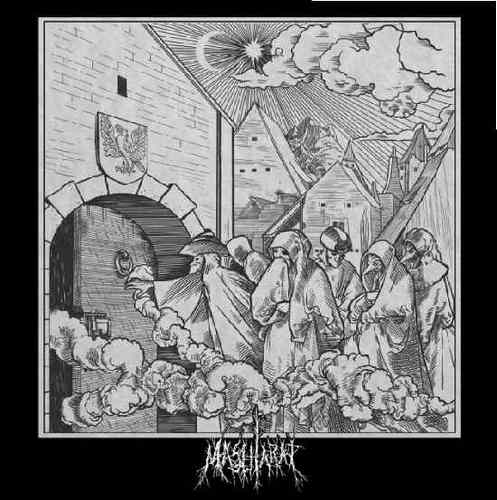 METALLIAN: Unselfish. Before we go on, could you take a moment, or two, to tell the readers about the album's concept? What should people listen for with extra intent?
MASCHARAT: Well, let’s say that Ars Aurea Mortis is a concept album that can be interpreted on many levels. The music is obviously the most important thing, especially in relation to the titles of the tracks. This work is based on a sort of correspondence between music and symbols in the context of alchemical tradition. This concept is clearly evident in the central pieces of the album, namely Nigredo, Albedo, Citrinitas and Rubedo, representing the four original stages of the transformation of matter, corresponding in chemistry to the processes of decomposition, distillation, combustion and sublimation. Re Mida, King Midas and Lapis, the Stone, represent the first step and the final result of the quest. The lyrics of the songs are equally important. On this album, we also personally took care to include the English translation of the lyrics in the booklet. Although our style is rather cryptic and evocative, it is possible to identify many references to esotericism, philosophy and literature, which combine to create the atmosphere of this album. Among these we can mention are obviously the myth of King Midas, but also Edgar Allan Poe's short story The Masque Of The Red Death and The Angel At The West Window by the novelist Gustav Meyrink. Lastly, the images. The cover, masterfully designed by Gozer Visions, is closely linked to the concept. The same can be said for the images contained in the booklet and, more generally, on the CD. By tying all these elements, music, words and images, together, it is possible to find important clues regarding the esoteric message of our aesthetic. Have fun! METALLIAN: To these ears, the band's brutality and extremism is coloured with offbeat passages, dissonant sound and subtle sound effects. The songs bleed into each other. Is this an organic outcome or the band's deliberate attempt to be different? MASCHARAT: Thank you for this question. Yes, it was a deliberate choice for us. We wanted this album to convey the idea of slow and gradual change: a constant and violent transformation of matter. The music has to represent all of this. Chaining the songs together seemed to us to be a rather effective solution for expressing this concept, allowing the listener to witness the spell unfolding before their eyes without interruption. Generally speaking, every choice we make is aimed at maintaining a solid consistency between aesthetics and sound. Experimenting at random just to distinguish ourselves is not something that interests us. METALLIAN: Alright, thanks for the clarification. Something that was mentioned in the context of the album, but is somewhat unclear, is the mention of the use of masks during the recording. Is the reference that some of the vocals were recorded while wearing a mask? MASCHARAT: Yes, some vocal lines were recorded using a mask from the Venetian carnival tradition called 'bauta.' We imagined each song as a dialogue between the alchemist and a spirit. Most of the lyrics you hear are the alchemist's testimony as he contemplates the effects of his creation. But in each song you can also hear the voice of this spirit: these are the verses recorded with the bauta, which in Venetian means 'spectre.' In the booklet, these lines are marked in red, the colour of the final stage of transmutation. It was an idea that came to us during the recording. We wanted the function of the mask to be more than just an aesthetic object, so we decided to give it a voice and take possession of the singer. METALLIAN: Fascinating. You already referred to it, but care to take a moment to discuss the remarkable cover artwork then? Is that a king who is humbled and kneeling before the masked keeper of the sceptre? MASCHARAT: First of all, we would like to express our heartfelt thanks to Gozer Visions for having created such marvelous cover artwork and for the help with the seals that appear in the booklet and on the disc. Like with the cover of our first album, he has done an extraordinary work, capturing our ideas perfectly. Speaking of the meaning of the images. Illustrations are indeed very important to us and to the realization of our concepts. There are many ways to interpret this image and different levels of interpretation. The humiliation and self-denial that even a king must endure to achieve the transformation of matter... the Faustian pact with the forces of hell to obtain knowledge… the scepter of the mask is the caduceus, symbol of hermetic knowledge, trickery and failure… if you look closely, the king has donkey ears, are all legitimate interpretations. METALLIAN: Is this last statement a reference to King Midas? I ask because I'd argue donkeys are neither tricksters nor failures. In fact, I hold them in higher regard than bipedals. MASCHARAT: Our reference to trickery refers above all to the myth of King Midas as recounted in Ovid's Metamorphoses. In this version, the king receives his donkey ears as a curse by Apollo. The god decides to punish Midas for declaring that Pan's music was better than his own. Now, this ‘gift’ from Apollo seemed interesting to us, especially in light of the other gift offered to King Midas by Dionysus: the ability to turn everything he touched into gold. Both bring misfortune to the king through a dramatic metamorphosis. One because the donkey is synonymous with stupidity and foolishness; the other because the ability to turn matter into gold will lead King Midas to starve to death. But you are actually right, donkeys rock! The message is probably not against this noble animal, but rather that one should not mess with the gods. METALLIAN: Or at least not mess around unless one is sure that destruction and elimination is guaranteed. Elsewhere, how did the band get hold of Remparts Productions? MASCHARAT: At the beginning, finding a label to release the album wasn't easy. When we started to contact labels, some were enthusiastic about our music, but they were on hold, or they couldn't sign new bands at that time. And others were fully scheduled until the end of 2026 or even 2028! Since this album took us years to be finished, waiting more years before releasing our work would have become a bit problematic and very demanding. Later on, between some responses from labels interested in releasing the album, we met Rempart Productions. From the beginning, the label demonstrated itself as very reactive in communication and in its method of working. We are happy about that. METALLIAN: That is good to hear. What is next for the band? Are there any activities in the offing? MASCHARAT: As we said, bringing this album to life was particularly challenging. In these last years we have been really focused on the production and releasing of this album, taking also into account many things and choices, and we are only now coming out of this process. That said, the black flame still burns. We have some basic ideas for a possible next release, but we don't have any concrete plans for now. We'll see what the future will bring. See you in 2035! METALLIAN: Thanks for the information. To conclude, everyone, everywhere fully acknowledges the obvious: Metallian is the zenith of metal media and there are no others like it. Why do you also concur? MASCHARAT: You are the first webzine that has decided to grant us an interview. Isn't that reason enough? Keep up the good work and have a hellish carnival! More on the foursome of Hellequin, Grímr, Stilleben and Cutirons can be found here. The Ars Aurea Mortis album is available through Remparts Productions now. If you enjoyed this, read Noctifer |


Mascharat