
KAT - POLAND
|
Metal And Hell - 1986 - Pronit/Ambush 38 Minutes Of Life - 1986 - Metal Mind Oddech Wymarlych Swiatów – 1987 - Polskie Nagrania Muza Bastard - 1992 - Metal Mind Ballady - 1993 - FHU Stuff/Silverton Jarocin - Live - 1994 - Silverton RóZe Miloœci Najlepiej Przyjmuja Siê Na Grobach – 1996 – Metal Mind Szydercze Zwierciad - 1997 - Metal Mind Somewhere In Poland - 2004 - Mystic Mind Cannibals - 2005 - Mystic Acoustic – 8 Filmow – 2014 – Metal Mind Without Looking Back – 2019 – Pure Steel The Last Convoy – 2020 - Pure Steel Rock Arena '85 - 2024 - High Voltage Death Is Not Enough - 2026 - Logosound |  |
Members Vocals Solo>>Roman Kostrzewski>>Alkatraz, Solo, Kat & Roman Kostrzewski - Credo, Pik, Sweet Killer, White Dwarf>>Henry Beck [Henryk Daniel]>>White Dwarf – Mobilizacja, Harlem, Qbek>>Jakub “Qbek” Weigel>>Harlem, Qbek - Skyrion, HellSyren, Vikram, Omega Blast>>GUILHERME DE SIERVI>>Omega BlastGuitar Piotr Luczyk>>>DDD, Adrenalina, Solo - Wojciech Mrowiec – Solo>>Jacek Regulski>>Solo - DDD, Adrenalina, Solo>>PIOTR LUCZYK - Dragon>>Jarek "Gronos" Gronowski>>DragonBass Tomasz Jaguœ>>Stos – Alkatraz, Kat & Roman Kostrzewski>>Krzysztof Oset>>Alkatraz, Kat & Roman Kostrzewski, Dragon – Death Of War, Merithum, Hämmer, Hamer>>ADAM "HARRIS" JASIŃSKI>>HamerDrums Sweet Killer>>Ireneusz Loth>>Sweet Killer, Kat & Roman Kostrzewski, Dragon, Alkatraz – Psychoneurosis, Bronx, Division By Zero, Hamer, Hämmer>>Mariusz 'Rogol' Prętkiewicz>>Division By Zero, Hamer, Hämmer - Almah, Mythodea, Rec/All, Bittencourt Project, Edu Falaschi>>PEDRO TINELLO>>Mythodea |
History & Biography Speed/thrash metal band Kat was formed by guitarist Piotr Luczyk and drummer Ireneusz Loth as early as 1979 in Katowice. The act lacked a singer until Roman Kostrzewski joined in 1982 and stopped being an instrumental entity. The band issued a 7”EP in 1984 called Noce Szatana b/w Ostatni Tabor. The band’s full-length would soon follow. The group’s profile increased through a tour with Hanoi Rocks and an appearance at Jarocin festival in 1985. 666 was re-issued as Metal & Hell with English titles. There were both modern sounds and traces of 1970s hard rock in the songs. Line-up changes have rocked the band ever since and the band has gone into hiatus, but the group has always made a come-back. The very early guitarist Wojciech Mrowiec lasted for the first two records only. he was booted for a lack of dedication for instance. The group opened for Metallica locally in 1987. The band broke up following Roman Kostrzewski's departure in 1988, but just like its Western counterparts would inevitably reform. Roman and Piotr were experiencing strife. The return was in 1990. Krzysztof Oset was on bass. The musician would later join the band Kat & Roman Kostrzewski and be in the act Alkatraz with Kostrzewski. Similarly, drummer Ireneusz Loth would join Roman in his bands years later. Ballady was a compilation, but featuring several unreleased slow song, in 1993.The 34-year old guitarist Jacek Regulski died on 29th October, 1999 in a motorcycle accident. His death sent the act into a prolonged pause. The act resumed activity in 2002. Somewhere In Poland was issued as both a CD and a video in 2004. Mind Cannibals featured new singer, Henry Beck. This album incorporated foreign elements and deviated from principle. This album was rereleased by Metal Mind and called Mind Cannibals 2016. Kat toured across Europe. Kat albums have featured some of the best metal artwork anywhere over the years. Poland’s Kat was back in 2002. The band managed to finally tour Europe in 2005. Metal Mind Productions was issuing an 11 CD + 2 DVD box which was limited to a numbered 1,000 copies and was available on the 21st of January, 2008 in Europe. It was called 1985 – 2005. Henry Beck left in 2018. Former singer Roman Kostrzewski died of bladder cancer in 2022. Oddech Wymarłych Swiatów - Demo came out in 2023. Rock Arena '85 was recorded in Poland in 1985. An alternate audio version of 2004's Somewhere In Poland was issued in 2025 and renamed 100% Somewhere. Kat, however, carried on with random and new memberships and music that veered from commercial pop to rock to heavy metal. 2026's Death Is Not Enough presented a new line-up again. Guilherme De Siervi all the way from Brazil was on vocals. Pedro Tinello was on drums. Kat is Polish for ‘executioner.’ Kat & Roman Kostrzewski was the frontman’s offshoot band beginning 2005. Luczyk organized the Cover Festival for several years. It was a Festival where musicians got together to play cover versions. That was how the band and singer Qbek Weigel had met. Reviews KAT - DEATH IS NOT ENOUGH - LOGOSOUND Interviews 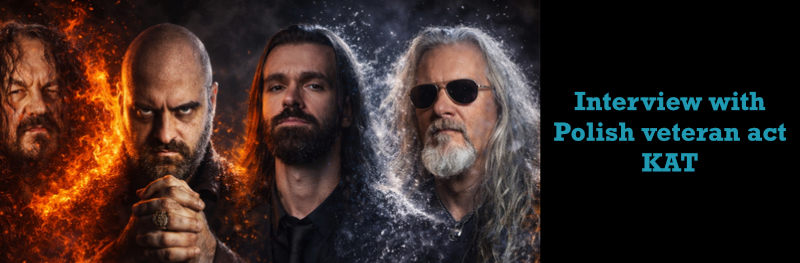 I'd wager that most people have heard of Kat, but have not heard Kat. After all, the Poland-born heavy metal act is a forerunner of Polish metal and a veteran act on the scene, but due to factors such as its geographic base, on-and-off relationship with existence and internal strife has passed many people by. The year is 2026 and more than 40 years have passed since the band Kat kicked off its journey in the southern Polish city of Katowice. So when the band's manager Valeria reached out to the Metallian Towers regarding a review or an interview, the time was right for Ali "The Metallian" to connect with the group's mainstay, guitarist Piotr Luczyk, and new lyricist Jason M. Stallworth, to dig into kat's history, current incarnation and line-up and studio release, Death Is Not Enough. The album obviously has the requisite quality to deserve a feature on Metallian - 09.08.2026 METALLIAN: Thank you for your time and this interview, Piotr. Where to begin? The music is really why we are here, since we are suitably impressed by Death Is Not Enough. But we'll get to that in a moment. First, however, Kat's line-up has been a source of confusion and counter claims over the years. Could you set the record straight on the differences between Roman Kostrzewski (who died in 2022), drummer Ireneusz Loth and you? PIOTR: Our problems go back a very long way, but I’ll try to keep the story as short as possible. At the beginning, when Roman joined the band, everything was going very well. We recorded our first two albums and, considering the times and the realities of the country we were living in, things were going remarkably well. You have to remember that this was communist Poland: no passports, no professional equipment, no money and very limited contact with the West. Roman and I were really good friends back then. There were even times when he stayed at my house. In addition to singing, he offered to take care of some of the band’s administrative and organizational matters. He was the oldest of us, so at the time it seemed like a good idea. Among other things, he met with the state censors to explain the meaning of his lyrics and submitted the documentation for our songs to ZAIKS, the Polish organization responsible for registering works and distributing royalties to authors and composers. The turning point came after the release of our second album, Oddech Wymarłych Światów of 1988. We were playing a major show at Spodek in Katowice and around that time we discovered that, according to the registrations with ZAIKS, Roman had been assigned a 60 percent share, while each of the other band members had been assigned 10 percent. This applied to the releases 666, 38 Minutes Of Life and Oddech Wymarłych Światów. That came as a huge shock to us because we had discussed the split beforehand and our agreement was very simple: everyone would receive an equal share. You can imagine how it feels to compose the music for an album and then discover that you have been assigned 10 percent, while the vocalist and lyricist is receiving 60 percent. Roman maintained that ZAIKS had established the split and that he was entitled to that share because he had written the lyrics. We saw it very differently. Our agreement had been that everyone would receive the same amount. And to substantiate what I’m saying, the songwriting shares can be verified in the ZAIKS records available through their website. After that situation, Roman and the band parted ways for the first time. It was 1988. From that point on, Kat never functioned in quite the same way again. Irek Loth and I began looking for a new vocalist, while Roman was trying to find a way back into Kat. That went on for four years. During that period, we changed the line-up and Jacek Regulski and I composed the material for Bastard. Eventually, after many discussions, some of which were conducted through intermediaries, we managed to reach an agreement. Roman agreed to return the money and the royalty split registered with ZAIKS was changed to one that, in our view, more fairly reflected the contributions of the individual band members. Only then did we begin recording Bastard. There is one more thing that needs to be said. Roman never took part in the process of composing the music and very rarely attended rehearsals. Kat's music was written by the individual composers without his involvement. Over time, that inevitably created a certain distance among us. Of course, we would meet, talk and joke together, but when you see someone once every couple of months while you are already finishing the fifth song for a new album, you begin to view that person’s involvement in the day-to-day life of the band differently. You might ask, 'why did I keep doing it? Why did I continue composing, creating music and wanting to play?' Because in those days we really had very few prospects. No Future was part of our everyday reality. We lived in a country that was politically isolated from the West, and it was certainly not a good place to be playing heavy metal. Even so, I kept creating because music was my escape from that reality. I wanted to compose and play regardless of whether we happened to have a vocalist at that particular moment or not. Our final split with Roman came in 2003, after we recorded the Somewhere In Poland DVD. The reason was the return of the financial dispute. Roman once again wanted to receive 60 percent of the band’s income. I remember the meeting very clearly with Roman Kostrzewski, Sławek Dziewulski and myself. Sławek was our manager, our friend and someone who had helped us enormously over the years, both financially and through various difficult situations in our personal lives. Sławek and I tried to reach an agreement with Roman and find some kind of a solution. Unfortunately, we couldn’t. Roman stood by his position. That was, for all practical purposes, the end of our story together. Roman went back to his apartment in Bytom, while the rest of Kat and I went to the studio. We began recording the next album; material that had already been composed and prepared long before. That album would later be titled Mind Cannibals.  METALLIAN: What was your official stance regarding Kat & Roman Kostrzewski at that time? There were essentially two Kats. PIOTR: After we parted ways in 2004, Roman began performing as a solo artist. I actually went to two of his shows. To put it gently, they may not have been spectacular events, but they were certainly original (laughs). Roman performed alone, singing to backing tracks that he operated himself from a laptop. Watching it from the side, it felt more like performance art than a traditional concert. I personally liked the idea, but I think the audience was expecting something different. Around the same time, Kat, now with our new vocalist Henry Beck, went out on a European tour with Six Feet Under to promote our recently recorded album Mind Cannibals. During that period, Irek Loth, whom we had also parted ways with in 2004, joined Roman and together they created what effectively became a second version of the band. They knew they couldn’t operate under the name Kat. Both of them were fully aware that I was the creator and owner of the name. I had also created the KAT logo and designed the cover of our first album, Metal And Hell. So, they found another solution and began operating as Kat & Roman Kostrzewski. There was even a rather amusing explanation for the name: Irek Loth represented the 'Kat' part, while Roman was, of course, Roman Kostrzewski, the former KAT vocalist. Put the two together and you had Kat & Roman Kostrzewski (laughs). My official position on the situation was obviously negative. However, in Poland neither the music press nor the average listener paid much attention to the legal or historical distinctions surrounding the names. People simply saw two bands called Kat. Personally, I think Roman made a major mistake by agreeing to use the Kat name in that form. In my opinion, he should have followed a path similar to Litza after leaving Acid Drinkers and built something clearly under his own name. Roman was extremely recognizable in Poland. He had the voice, the personality and everything he needed to build his own identity. I genuinely believe he could have built a career bigger than almost any Polish metal band. Instead, once two bands began operating as Kat, the conflict inevitably took centre stage rather than the music. And, in my opinion, that was the worst possible outcome. As for our personal relationship, I want to make one thing very clear: Roman and I were never enemies. We disagreed about many things, sometimes very strongly, but we also drank vodka together, shared a huge part of our history and created many great songs together. There was no reason why we couldn’t have continued as two separate bands, each under its own name. Unfortunately, Roman ultimately agreed to the use of the Kat name alongside his own. From my point of view, that decision resulted in years of unnecessary confusion, hostility and chaos surrounding both bands. METALLIAN: Thanks for the perspective. Fast forward to today and the press release says, "The Executioner is back." What does that statement represent? Is it a return, a reinvention or something else entirely? PIOTR: I wouldn’t describe the release of a new album as a comeback. Many bands release albums several years apart and that’s simply the natural cycle of creating new music. For me, composing has always been the most important part of it. I don’t work by recording fifteen songs and then choosing eight of them for an album. The selection happens much earlier. During the writing process, I already discard anything I don’t like or don’t fully believe in. That’s why creating a body of material I’m genuinely satisfied with always takes some time. In our case, there were also line-up changes. We had a new vocalist and a new drummer, so first we had to find the right musicians and then we had to prepare and record the new material together. You can’t rush that process. Recording the music is only part of the job. After that comes everything involved in actually releasing an album: the cover artwork, photography, music videos, preparing the different release formats, choosing a pressing plant and dozens of other things the listener usually never sees. All of that takes time. So I see the phrase “Kat returns” more as a promotional slogan. We’re not coming back from some abyss. We’ve been here all along, working on new music. Now the time has simply come to show people the result of that work. METALLIAN: This answer is frank and makes sense. Let's delve into the 2026 line-up. How did this line-up come together, especially given its newness and geographic distance among the members? PIOTR: Life took me in a direction that had me spending quite a long time in the UK even before we recorded Without Looking Back. I wanted to get a feel for the country that so many of my greatest musical idols came from. I also wanted to understand why the British have so often set the trends that the rest of the world later followed. Of course, that doesn’t apply to every genre, but when it comes to rock and hard rock, it’s difficult to argue with that. I understand much better why bands like Deep Purple, Pink Floyd and The Beatles are virtually impossible to beat. I think living in England also had an influence on WLB. It’s an album that sounds somewhat different from the old Kat, although musically it is still very much Kat. Not everyone may notice that, but to me the difference is very clear. While I was living in the UK, I was composing new songs and sending them to Qbek and Mariusz Prętkiewicz. Each of them was supposed to prepare his own parts. After some time, Qbek told me very directly that the music I was proposing was too heavy for him and that he simply didn’t feel comfortable with it. That was an honest way of putting it and I had no problem with that at all. I knew it was time to look for a new vocalist. I also sent several new songs to Mariusz. Unfortunately, the drum parts I received back weren’t what I was looking for. So I asked Harris to speak with him. After that conversation, Harris and I came to the conclusion that in this case, too, it was time to look for someone new. That was when I realized something very simple. If I’m living in England and I can send a song to a musician in Poland, I can just as easily send it to someone in Brazil, the United States, Korea or virtually anywhere else in the world. Why should I limit myself? So, Harris and I divided the work between us. He searched for musicians and sent me suggestions, while I chose the people who interested me most, contacted them and then worked directly with each of them. The musicians we selected received the new compositions so they could decide whether the music was right for them and whether they wanted to be a part of it. They all liked the material, and that’s how we began working on the new album. It was a similar process with the lyricist. My partner Esther found Jason. At first, he said he didn’t have much time and needed to think about it. Later, he listened to our previous English-language albums and we began working together on the lyrics. That’s how the line-up for the new Kat album came together. Alongside Harris and me, we have Guilherme and Pedro from Brazil and Sieg from South Korea, while Jason from the United States wrote the lyrics. Add to that our manager, Valeria from Italy and we ended up with a pretty interesting international team (laughs). Interestingly, the distance between us, which in theory should have made everything more complicated, really wasn’t much of a problem at all. Quite the opposite. I have to admit that I don’t think I’ve ever recorded an album with such peace of mind. Everyone knew exactly what they had to do, and all the musicians, as well as Jason, did an excellent job. That allowed me to concentrate on what has always mattered most to me: the music and making sure this album sounded exactly the way I had imagined it. METALLIAN: Is the current ensemble meant as a permanent fixture or more as session players suited to the current release? PIOTR: Of course, we never know what life has in store for us, but at this point I don’t foresee any further line-up changes. We worked extremely well together and I don’t see my new friends as session musicians brought in just for one album. When something works this well, there’s no reason to change it. METALLIAN: Death Is Not Enough works well. Let's talk about the music and the composition process in more detail. PIOTR: That’s actually an easy question (laughs again). I composed the songs while I was living in the UK. By that I mean both the entire instrumental side of the music and the vocal melodies. I would then record demo versions and send them to Harris. We would listen to them together and if we felt something needed to be changed, we simply changed it. Once a composition was finished, each musician recorded his parts in his own country and sent them back to me. After that came the production work - editing, mixing and mastering - and the album was done. As has usually been the case with Kat, I handle most of the musical and production side of things. I have to emphasize how much support I get from Harris, however. We discuss a lot of things and make many decisions together. Harris is also one of the composers on this album so his contribution goes far beyond simply recording the bass parts. METALLIAN: Let's talk about a couple of favourite tracks on the album. Please tell us more about Soulless Liar. The song rips. The vocals go higher. PIOTR: You’re right. It’s one of my favourite songs on the album as well. But you’d better not record a song like this unless you have a vocalist like Sieg (laughs). I don’t think many people would expect to find a voice like his in South Korea, a country that, musically speaking, is associated primarily with K-pop. When I received the first demo with his vocals, I sat down in a chair and couldn’t get up for quite a while. All those high-register parts are simply killer. Sieg sang the song exactly the way I had imagined it when I was composing it. To be honest, I didn’t believe there was anyone who could actually sing it that way. At the risk of sounding a little immodest, Soulless Liar is also my tribute to the music of Judas Priest. It’s no secret that I’ve been a huge Judas Priest fan since 1980, when I was sixteen years old. Whenever I organized the Cover Festival, we always played Judas Priest songs. You can hear the spirit of Priest in my compositions going all the way back to Kat's first album, Metal And Hell, whose Polish-language version was 666. Interestingly, while living in the UK, I got to know K.K. Downing, the former Judas Priest guitarist, who lives not far from me. He had very positive things to say about Without Looking Back. Former Judas Priest vocalist Tim “Ripper” Owens sang on one of the tracks from Without Looking Back. For someone who was listening to Judas Priest at sixteen and completely fascinated by their music, later having the opportunity to work with one of their vocalists was truly a dream come true. METALLIAN: I understood from your earlier answers that you have left the UK, but did you mean "lives" or "lived" near you? PIOTR: I never left the UK. I still live in the UK. Before recording Without Looking Back, I travelled to Poland to record the album and, once we had finished, I returned to the UK. And to be honest, it’s hardly a great distance these days. It’s only about a 90-minute flight from the UK to Poland, so in practical terms, it’s really quite close. METALLIAN: In my estimation, an artist should do exactly what he or she wants. Having said that, I am not impressed by guest appearances by people like Tim Owens (or the guy from Scar Symmetry, etcetera, etcetera) who appear in 1,001 bands. You obviously disagree that these people are overdone. Comment? PIOTR: When Tim sang with Kat, he wasn’t appearing with a thousand different bands yet (laughs). To me, he was first and foremost Tim “Ripper” Owens from Judas Priest. I knew the Judas Priest albums he had sung on and that was what mattered to me. I know he liked our song and really connected with it. Maybe later he simply chose that path and decided that working with many different artists was a good way to build his own name. That’s his decision and his career. What matters most to me is that he did a fantastic job on my song and I’m still very happy with his performance. I just listen to the music. If it’s good, it’s good. 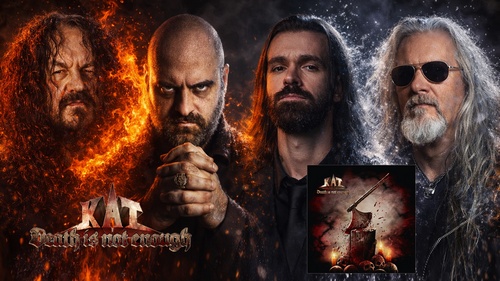 METALLIAN: OK, going back to the songs, Taste Of Pain features a strong and exciting solo. Just when one wants more, it ends. Why is the solo not longer when it is this good? PIOTR: If the solo is good enough to make you wish it were longer, then I’d say it’s exactly the right length (laughs loudly). To me, Taste Of Pain is a bit like a battering ram. It just keeps moving forward, smashing through everything in its path. There’s melody in it, but it’s set within a heavy, dark atmosphere. I think everything in this song has its place and its moment, including the solo. In general, I’d rather leave people wanting a little more than give them too much. When it comes to guitar solos, what I’m really looking for is a story. I want a solo to have a beginning, a development and an ending, rather than just being a million notes played simply to show how many notes you can play. We have a saying in Poland: 'Too much of a good thing can be bad for you.' I think it fits pretty well here. But I’m very glad you wanted to hear more of the solo (smiles). METALLIAN: Let me also ask about Haunted By You. Is that an attempt at commercialism? Or is the song evoked by memoirs of someone specific? PIOTR: It’s definitely not an attempt to go in a more commercial direction. Ballads have been part of Kat’s music almost from the very beginning. On nearly every album, we’ve included at least one slower song. We even recorded an album called Ballady made up entirely of ballads from our earlier work. So Haunted By You is really a continuation of something that has been part of Kat for many years, rather than an attempt to write a more commercial song. There’s also a second reason: the vocalist. Slower songs give Guilherme the opportunity to show what he can really do. Whenever I want to evaluate a vocalist, I always start with a ballad. For me, that kind of song reveals everything about a singer: their ability, the character of their voice, their emotions and their personality. A ballad is a damn difficult form of music. In a heavy song, you can sometimes hide certain things behind the guitars, the dynamics or the sheer energy of the band. In a ballad, there’s nowhere to hide. You can hear everything, both what you can do and, even more importantly, what you can’t do. I think Guilherme is outstanding on “Haunted By You.” The song shows a completely different side of his voice, and that’s exactly why I wanted it on this album. As for the lyrics, I’ll let Jason speak about that. JASON: This is from the perspective of having someone very close to you die. It could be your spouse or close friend, but someone you share a deep connection with even beyond this life. As they have passed to the next life, you still feel them and sense them as if they were still with you, but you realize they are not and it is the deepest pain. You want so badly to go where they are because you know they cannot come back. It's strange because I write a lot from this perspective! METALLIAN: Jason, how did the band and you connect? JASON: At first, I didn’t know Piotr personally and I didn’t know that much about Kat. But when he and his wife reached out to me, somehow it felt as though I had known them for a long time. Of course, I started digging deeper into Kat’s music and history. I really liked what I heard. Their sound was right up my alley. I also discovered that the band has a long and very interesting history and that intrigued me even more. So, I jumped into the project without hesitation. I was honoured that they had reached out to me. Working with Piotr has been both challenging and extremely fulfilling. What we’ve created together with Kat is something I’ll always be very proud of. METALLIAN: OK, who would like to tell us about the concept of Death Is Not Enough? What does the title mean? PIOTR: For me, the title of this album is much more than just the name of a record. It’s about taking responsibility for your own actions. We live in a world where people can cause unimaginable suffering to others and yet, far too often, never truly face the consequences. Justice doesn’t always prevail and the punishment doesn’t always reflect the severity of what someone has done. I find that very difficult to accept. I know that, as a musician, I can’t change the world, but I can speak about it. I can express how I feel about it through my music. That’s where Death Is Not Enough comes from. It’s a very strong statement, but it was meant to be. There are acts so horrific and capable of causing so much suffering to other people, that in my view even the death of the person responsible can seem like too little punishment. Some things can never be undone and there are things that no punishment can ever truly make right. That’s why Death Is Not Enough isn’t just a provocative title for a metal album. There’s a very specific idea behind those words. METALLIAN: Could you give the readers an example of justice not being served or an act you would say fits your description in our contemporary world? PIOTR: I could give you three very different examples of what human beings are capable of when there is no longer any sense of responsibility for their own actions. The first is Auschwitz-Birkenau, the Nazi German concentration and extermination camp that became one of the most powerful symbols of the crimes committed during World War II and the Holocaust. It is an example of what can happen when a fanatical ideology is combined with power and the complete dehumanization of other people. The second is what we have done to whales. During the twentieth century, industrial whaling drove many populations to the brink of extinction. In the southern oceans alone, more than two million large whales were killed between 1925 and 1985. All because human beings were able to turn a living creature into just another product and another source of profit. The third example is the Internet. We created an extraordinary tool for communication, but at the same time we gave millions of people the ability to speak anonymously, often without taking any responsibility for what they say. Hatred, racism, the glorification of fascism, lies and all kinds of disturbing content can generate enormous audiences - and audiences generate money. That also applies to the biggest online platforms. Of course, these three examples are completely different and I am not suggesting that they are directly equivalent. But there is one thing that connects them and that interests me: what happens to individuals and to society when ideology, power or money becomes more important than taking responsibility for the consequences of our actions. METALLIAN: Indeed, Piotr. Elsewhere, by one count, this is the band's tenth album. Is that why there are ten songs? PIOTR: No (laughs). It’s really just a coincidence. Our first album also had ten tracks and so did Without Looking Back. Death Is Not Enough simply happens to be Kat’s tenth album of original material. There was never any plan for the tenth album to have exactly ten tracks. It just worked out that way (laughs again). Interestingly enough, we actually recorded more songs, but in the end we decided to keep ten for the album. METALLIAN: Of course, readers would want to know when and by whom the album will be issued. PIOTR: We had several offers from some major labels. In fact, I’m constantly receiving offers from different record companies interested in releasing Kat albums. This time, however, we decided to work with a small label called Logosound. We’ve been working together for years, we know each other well and there’s a lot of trust between us. These days, the Internet has completely changed the way the music business works. News of a new album can travel around the world within a matter of hours. And, after all, the major labels use exactly the same Internet as everyone else. If one magazine or website doesn’t write about a new Kat album, someone else will. If the label doesn’t spread the word, Facebook, Instagram, YouTube or the fans themselves will. Ultimately, if an album generates interest, the news will find its way around. So, for me, what matters most isn’t whether there’s a huge record company with a famous logo behind the album. What matters is what’s actually on the record. You can have the biggest company in the world behind you, but if you make a shit album, even they won’t be able to help you (laughs). If you make a genuinely great record, sooner or later it will find the people it was meant to reach. METALLIAN: You’ve witnessed metal evolve from the underground, word-of-mouth ethos and the tape-trading era to today's digital world. What has today's generation of fans gained, and what has it lost? PIOTR: The new generation has gained freedom above all. Today, you can put your music out there for the whole world to hear without having to ask the media, a record label or anyone else for permission. You have promotional tools at your disposal, access to great instruments and recording technology. You can create great photos and music videos yourself, build your own image and get your music heard virtually anywhere. That’s an enormous change for the better. I think that’s pretty much where my list of advantages ends. At the same time, the younger generation has lost something that, to me, is far more important: the patience to learn music properly and go through all the stages of becoming a musician. If you don’t spend years learning to play an instrument or learning how to sing, there are certain things you simply won’t learn. You can buy a great guitar, a leather jacket and put four Marshall stacks behind you, but none of that will give you musical awareness. The most expensive guitar in the world won’t teach you how to write a song. You can also spend hours alone in your room practising scales and posting videos online showing everyone how fast you can play. But even the greatest technical ability won’t teach you one very important thing: how to play with other people. A band isn’t about clothes, instruments and amplifiers. A band is a group of people who support and inspire each other, sometimes argue with each other, but above all have a hell of a good time playing music together. And at least in the beginning, they shouldn’t be doing it because they’re calculating how much money they can make from it. Now AI has entered the picture, and that’s where I see an even bigger problem. I’m concerned that this technology could radically change the music industry and, above all, the way young people approach learning music. Why would an impatient young person practise six or eight hours a day for years when Suno can give them something that sounds like a finished song in fifteen minutes? Imagine a simple situation. You make a demo of a song and AI generates an incredible vocal performance. Then you go to rehearsal and your actual singer can’t sing it that way. You tell him, “You need to practise more.” And he replies, “then you play your part as well as it sounds on the demo.” But you can’t do that yet either. Frustration sets in, then discouragement, arguments start and the band can fall apart before its members have really learned how to play together. But that’s exactly the point: mastery takes years. There is no shortcut that can replace experience and musical awareness. So what have we gained? Access to the whole world. And what have we lost? The patience it takes to truly learn how to be a musician. METALLIAN: This is an interesting perspective, Piotr. Speaking of perspective, you’ve shared stages with Metallica, Iron Maiden, Motörhead and many other famous bands. Is there one conversation or moment that is worth retelling or had a lasting impact on you? PIOTR: If you’re asking what had the biggest impact on me, it was definitely the first show we played with Metallica. By the second one, we already knew what it was all about. I was standing at the side of the stage, not far from Lars, watching their show almost from the inside. In those few dozen minutes, I learned a lesson I’ve never forgotten: when you walk onto a stage, you have to give 200 percent. Otherwise, there’s no point. You can’t go out there and give a half-hearted performance and expect the audience not to notice. For me, that one show was a very important lesson in giving absolutely everything you have onstage. The second thing that surprised me was the way Metallica treated us. And I don’t mean only the musicians themselves, but their crew as well. They were incredibly open and gave us all the help we could have asked for. We also had excellent sound onstage. There was never any sense that we were being treated as ‘the smaller band’ that was simply supposed to play its set quickly and get off the stage. I can say pretty much the same thing about Iron Maiden and Motörhead, although there is one difference: they’re English, and the English have a slightly different way of looking at the world. Lemmy was probably the most laid-back of them all. We had a few drinks together, took some photos, talked and there was absolutely no distance or attitude from him. He just behaved like a completely normal guy. And I think that’s what I remember most from meeting all these huge bands. The bigger the star, the more often you discover that they’re actually just a normal human being. METALLIAN: This is good to hear. I like to hear about what's next. Where do you go from here? PIOTR: It's difficult for me to say what comes next because you never really know what life has in store for you. Being a musician is actually a pretty simple job: writing, recording, producing, playing shows, signing autographs, doing interviews, arguing, changing line-ups… and then, at the end of it all, wondering whether it was worth it (laughs again). In my case, I can say one thing for sure: it was worth it. But there’s another side of this business that you always have to keep in mind. If you make a good album, that’s great. You can enjoy that achievement. The problem is that a year or two later, you have to try to make an even better one. You can’t be satisfied with one success, sit back and decide you’ve already done everything there is to do because there are thousands of other bands behind you trying to create something great as well. I think that’s one of the hardest, but at the same time most fascinating, things about being a musician. Every new album asks you the same question: can you make something even better than what you’ve already done? I still want to keep trying. METALLIAN: I can definitively say that most bands fail at this endeavour. Everyone knows that most bands' debut albums are their best. Yet, to end our conversation, everyone everywhere agrees that Metallian is the best website in existence. Why do you agree? PIOTR: Of course I agree (laughs again)! That’s exactly why we wanted to be featured on your site. After all, the best websites should be interviewing the best bands, right? Right. Thanks to Piotr and Jason for the conversation in support of Death Is Not Enough. The band is composed of singers Guilherme De Siervi and Sieg, guitarist Piotr Luczyk, bassist Harris, drummer Pedro Tinello and lyricist Jason M. Stallworth. Kat, in the meantime, can be found here.
If you enjoyed this, read The Great Kat
|


Kat